An educational 1U CubeSat model (Mission 1’s), not flight hardware. Energy and health readings are simulated. Not to scale: Earth is a backdrop. Drag to turn, pinch or scroll to zoom, tap a part.
01 · Discover
Ages 14–18
Find out how a spacecraft stays healthy, from its sensors to safe mode, through interactive 3D missions.
The research method, drawn: telemetry against a model, a residual crossing its threshold, and the validation stages ahead. No measured data; the platform is planned.
03 · Research
Applied Teams
Applied teams take the work towards verified algorithms, open datasets and academic and industry validation.
Records interest only; it does not confirm selection.
A CubeSat (10 cm), a model rocket (50 cm) and a CanSat (a drink can), side by side at the same scale. Separate exhibits, not one scene.
Ages 14–18 · Space Academy
Your mission starts in Space Academy
Learn space technology through interactive 3D missions, guided experiments, CanSat exploration and model rocketry.
Seven learning tracks for ages 14–16 and 17–18, and interactive 3D missions you can play in your browser. Online classes and CanSat and Model Rocketry workshops are planned.
How does a spacecraft know whether it is healthy?Space Health Explorers is a planned programme for students aged 14–18 exploring spacecraft health from first principles.
Spacecraft subsystems
Telemetry and sensors
Safe mode and redundancy
Mission communication delays
Basic anomaly reasoning
CanSat or simulated mission-health activity
Engineering ethics and safety
One Mission
Can a spacecraft understand its own health and recover safely?
Observe. Diagnose. Recover. Verify.
Learn the science
Autonomous Spacecraft Health Management is the capability to observe spacecraft telemetry, detect and isolate faults, predict mission impact, and recommend or execute verified recovery actions within bounded safety limits.
Simulated telemetry · illustrative scenario
Stage 1 of 6
Observe telemetry
Every minute the spacecraft samples its own health: voltages, currents and temperatures. In sunlight the battery charges normally: 7.9 V and 18 °C.
Pack
7.90 V
Cells
3.95 / 3.95 V
Battery
18 °C
Load
4.2 W
Chart data
Simulated battery pack voltage at each stage
Stage
Minute
Pack voltage
Observe telemetry
30
7.90 V
Detect anomaly
113
7.02 V
Diagnose fault
117
6.91 V
Predict impact
120
6.92 V
Recover safely
126
6.93 V
Verify recovery
187
6.58 V
Without action: cut-off
182
6.00 V
Battery pack voltage, simulated Expected in sunlight
Engineering detail
Telemetry is judged against what the orbit predicts. In sunlight, at this state of charge, the pack should read 7.6–8.4 V. Data is stored on board and sent down at ground-station passes, which can be hours apart, so the spacecraft has to judge its own health between them.
Orbit: 500 km, one revolution every 94.5 minutes, up to 35.7 minutes of each in Earth’s shadow. The battery pack (two lithium-ion cells in series) is the unregulated battery bus; the computer and radio run from regulated 3.3 V and 5 V rails, which hold steady until the pack nears its 6.0 V cut-off.
Stage 2 of 6
Detect anomaly
Still in sunlight, the pack falls to 6.9 V, below its expected 7.6–8.4 V, while the array still delivers 1.1 A. After 3 low samples in a row, the flight computer raises an anomaly flag.
Pack
6.90 V
Cells
3.98 / 2.92 V
Battery
27 °C
Load
4.2 W
Engineering detail
Rule: pack voltage in sunlight below 7.6 V for 3 consecutive one-minute samples. The persistence filter stops a single noisy reading from raising a false alarm.
Detection runs as fixed, testable rules on the flight computer (thresholds and rates of change), so it can be verified before flight.
Stage 3 of 6
Diagnose fault
The array current is normal, so the panels are not the cause. Per-cell telemetry shows cell 2 at 2.92 V against 3.98 V, and the pack is 9 °C warmer: a degrading battery cell.
Pack
6.90 V
Cells
3.98 / 2.92 V
Battery
27 °C
Load
4.2 W
Engineering detail
This is the isolation step of fault detection, isolation and recovery: each candidate cause is checked against the evidence.
Solar array degraded: ruled out: the array still delivers 1.1 A.
Battery cell 2 degrading: most likely: 1.06 V below cell 1 (healthy cells in series stay within a few hundredths of a volt) and the pack is 27 °C.
Stage 4 of 6
Predict impact
About 2.0 Wh is left above the 6.0 V cut-off. At the normal 4.2 W load the pack would reach cut-off about 29 minutes into the next 36-minute eclipse, and the computer would brown out.
Pack
7.00 V
Cells
4.03 / 2.97 V
Battery
27 °C
Load
4.2 W
Engineering detail
Time to cut-off = energy left ÷ load = 2.0 Wh ÷ 4.2 W = 29 min, shorter than the 35.7-minute eclipse. Below 6.0 V the power board disconnects the loads: the computer resets, the payload stops, and the weak cell is pushed deeper into discharge.
Simplification: voltage is taken to fall in proportion to the energy left; real lithium-ion curves are flatter in the middle and steeper at the ends.
Stage 5 of 6
Recover safely
The system recommends safe mode: payload and transmitter off, beacon only, charging slowed. At the Supervised level an operator approves it before it runs. The load falls from 4.2 W to 1.5 W.
Pack
7.00 V
Cells
4.03 / 2.97 V
Battery
24 °C
Load
1.5 W
Engineering detail
Safe mode is a pre-approved action, not an improvised one: payload and transmitter off, beacon on, charging slowed to spare the weak cell. Through the eclipse it uses 1.5 W × 35.7 min ≈ 0.89 Wh, leaving 1.11 Wh above cut-off.
At the Supervised level the recommendation, its evidence and the predicted outcome go to an operator, who approves it before it runs. It can be reversed.
Stage 6 of 6
Verify recovery
Through the next eclipse the battery pack stays at or above 6.55 V (criterion: at least 6.4 V), the battery cools to 22 °C (at most 30 °C) and the beacon stays on. It stays in safe mode until people decide what comes next.
Pack
6.55 V
Cells
3.60 / 2.95 V
Battery
22 °C
Load
1.5 W
Engineering detail
Criteria fixed before flight, checked through the next eclipse:
Lowest battery pack voltage 6.55 V, at least 6.4 V required: met.
Battery 22 °C, at most 30 °C allowed: met.
Computer and beacon powered throughout: met.
Returning to normal operations, for example with a shallower depth of discharge, is a decision for people on the ground.
Stage 1 of 6: Observe telemetry.
Illustrative scenario with simulated telemetry, built from stated teaching assumptions. Not data from any spacecraft, and not a validated or flight-ready autonomy system.
Level 1
Advisory
The system detects, explains and recommends. People decide and act.
Level 2
Supervised
The system proposes an action from a pre-approved list; an operator approves it before it runs.
Used in the scenario above
Level 3
Bounded Autonomy
The system may act on its own, but only within limits verified before flight, and it reports every action. Anything outside them goes back to people.
Generative AI must not directly control a safety-critical spacecraft loop. Autonomy is introduced gradually, under human supervision, and always within verified, bounded limits.
Why spacecraft need this
Future long-duration, autonomous, crewed, lunar and deep-space missions cannot depend on continuous ground intervention. A spacecraft must be able to observe its telemetry, detect anomalies, and isolate likely faults through Fault Detection, Isolation and Recovery (FDIR), predict mission impact, and recommend—or within verified limits execute—a safe recovery.
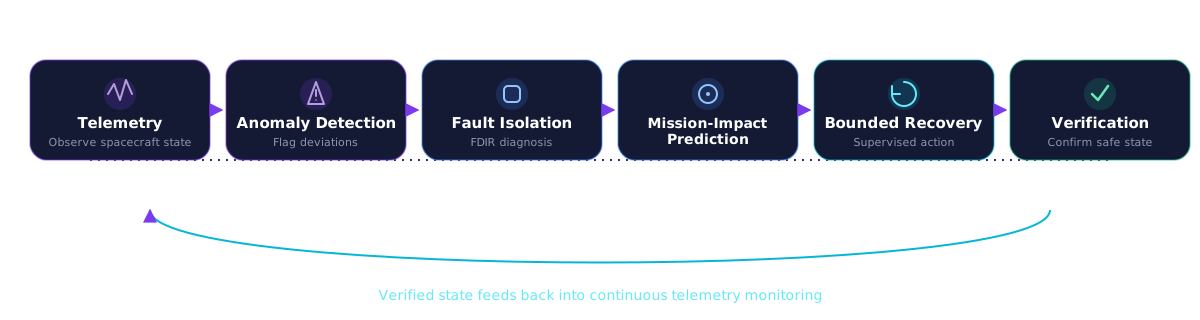
The full health-management loop diagram
Observe telemetry
Observe spacecraft state
Detect anomaly
Flag deviations
Diagnose fault
FDIR diagnosis
Predict impact
Predict mission impact
Recover safely
Supervised action
Verify recovery
Confirm safe state
Verified state feeds back into continuous telemetry monitoring
The autonomous spacecraft health-management loop: telemetry monitoring flows into anomaly detection, fault isolation (FDIR), mission-impact prediction, bounded recovery and verification, which feeds back into continuous telemetry monitoring.
Tutorials & Simulations
Learn by building mission-ready thinking
Guided simulation projects that turn spacecraft concepts into testable models, telemetry and engineering evidence.
Orbit sizes to scale with Earth; satellites enlarged. Gold: Earth observation, 700 km. Cyan: navigation, 20,200 km.
Interactive Learning Experience
Space Applications
How satellites and space data reach everyday life on the ground.
About this tutorial
Discover how satellites and space data improve everyday life—from weather and mobility to agriculture, connectivity, disaster response and infrastructure.
Educational reference · No aerospace background needed.
A 1U CubeSat, exploded into its subsystems: the Space Academy's own teaching model.
Flagship Advanced Program
Satellite Engineering
From First Principles to Spacecraft Systems Architect
Systems architecture and engineering leadership for spacecraft.
About this tutorial
A systems-level architecture and engineering leadership program covering mission design, spacecraft subsystems, digital twins, verification, operations, risk, cost and technical decision-making.
A Digital-Twin Simulation Platform for CubeSat Energy, Mission and Reliability Analysis
Sunlight in, loads out: a CubeSat's energy balance, simulated.
About this tutorial
Model orbit sunlight, solar generation, battery state of charge, mission loads, faults and safe-mode decisions through an interactive beginner-friendly laboratory.
Educational R&D prototype · Simulated data · Not flight software.
A generic modular station: modules, truss, solar arrays, radiators and a docked vehicle. Not a model of any real station.
Interactive Research Platform
Space Station
How orbital research stations are designed, powered and operated.
About this tutorial
Explore how orbital research stations are designed, powered, controlled and operated—from life support and microgravity laboratories to docking, robotics and future lunar stations.
Understand the Engine, then Engineer the Digital Twin
Pressure monitoring, fault detection and prognostics for a propulsion system.
About this tutorial
Build a physics-based, data-driven and AI/ML-assisted Digital Twin for an end-to-end rocket propulsion system, with a focus on pressure monitoring, fault detection, diagnosis and prognostics.
Advanced educational and research-oriented reference architecture · Simulated data · Not a proprietary or flight engine.
Research, Programme & Partners
For engineering students, academics, researchers and industry. Open any panel for the detail; every status is labelled as it stands today.
Long-Term Vision
Building capability for the missions of 2035, 2040 and beyond
Independent initiative. References to national space goals are provided for educational context and do not imply endorsement, affiliation or partnership with ISRO, IN-SPACe, NSIL or the Department of Space.
ShowHide the references
This research direction is aligned with publicly stated Indian ambitions, including long-duration missions, autonomous rendezvous and docking, the Bharatiya Antariksha Station goal for 2035, and an indigenous crewed lunar landing goal for 2040.
Prepared by the ISHAVASYAM.ORG technical team. Last reviewed: 14 August 2026.
Internships & Research
One multidisciplinary mission team
Engineering students work together as one mission team rather than on unrelated projects.
ShowHide the work areas
Reference mission: A 3U/6U CubeSat health-management test environment covering electrical power, thermal control, attitude control, onboard computing, communications and payload behaviour.
Mission and telemetry simulator
Fault injection
Digital twin
Anomaly detection
Fault isolation and diagnosis
Prognostics
Safe recovery logic
Cyber-resilient telemetry
Verification and safety assurance
Paid training and internships are distinct. Internships will be merit-based and governed by the published terms of each cohort; sponsored or stipended opportunities will be identified explicitly when available.
Planned Labs
Hands-on mission-health labs
Isolated, authorised simulations — not yet built. Express interest to help shape them.
ShowHide 8 labs
Planned
Telemetry & Mission Operations Simulator
Practice reading and reacting to simulated spacecraft telemetry streams.
Academic/industry design partner and flight-representative pilot.
5
Year 5
Demonstration
Independently verified prototype and startup-ready technology components.
Sustainable Access
How programmes will be funded
Availability, selection, fees, sponsorship and stipend conditions will be published for each programme.
ShowHide funding models
Participant-funded
Institution-funded
CSR-sponsored
Scholarship-supported
Grant-funded
Industry-sponsored
Partners
Partners & Engineering Ecosystem
APEX Rocket Systems and Gamyaa AeroSystems are working together in an engineering collaboration. The other organisations shown are proposed capability partners unless otherwise confirmed.
ShowHide the partners
Engineering Collaboration
APEX Rocket Systems
Rocket Propulsion · Integrated Launch Systems
Developing liquid-propulsion capability as a foundation for progressively integrated rocket systems.
More specialist partners are welcome across avionics, sensors, GNC, manufacturing, test infrastructure and research.
Ecosystem
Ecosystem and Responsibilities
Who is responsible for education, research, community and commercial work.
ShowHide who does what
Space is an ISHAVASYAM.ORG education, research and engineering initiative, hosted within the EV.ENGINEER engineering ecosystem. UFlight focuses on health and usage monitoring technologies for aerospace and autonomous platforms. Commercial engineering products and services, where applicable, are handled separately by iTelematics Software Private Limited under explicit agreements. Community membership is offered through EV Society, a separate community initiative.
FAQ
Common Questions
One mission: Autonomous Spacecraft Health Management and Safe Recovery — helping future spacecraft observe their own telemetry, detect anomalies, and recover safely with bounded, supervised autonomy.
No. This is an independent ISHAVASYAM.ORG initiative. References to national space goals are provided for educational context and do not imply endorsement, affiliation or partnership with ISRO, IN-SPACe, NSIL or the Department of Space.
School students (ages 14–18), engineering students, faculty and researchers, retired scientists and mentors, space startups and industry, government and institutional stakeholders, CSR and scholarship partners, and young founders.
Planned learning areas include spacecraft subsystems, telemetry and sensors, safe mode and redundancy, mission communication delays, basic anomaly reasoning, a CanSat or simulated mission-health activity, and engineering ethics and safety.
Paid training and internships are distinct. Internships are merit-based and governed by the published terms of each cohort; sponsored or stipended opportunities will be identified explicitly when available.
No. Student, academic, ISHAVASYAM.ORG, iTelematics and startup intellectual-property rights are governed through transparent written agreements. Participation does not automatically transfer a participant's IP to iTelematics.
No. The planned labs, the research platform and its digital twin described here are Planned or Research Direction items, not operational or validated products. Separately, the educational simulations and tutorial demonstrators on this site, such as CubeTwin, the Rocket Engine Digital Twins and the Space Academy missions, can be used now: they are teaching tools with simulated data, not validated engineering systems, and their availability does not make the research platform operational. Status is labelled honestly on each section. Participation in any programme is subject to its published conditions.
Use the Express Interest links on this page, which open our contact page: choose the enquiry type that fits, or Other. Sending an enquiry records your interest only — it does not confirm selection, admission, internship, stipend, funding, partnership or participation. For anything else, use the Partner With Us or Contact Us links, which route to our existing contact channel.
Not positioned as free. Programmes may be participant-funded, institution-funded, CSR-sponsored, scholarship-supported, grant-funded, or industry-sponsored. Availability, selection, fees, sponsorship and stipend conditions will be published for each programme.
Commercial products and services, where applicable, are handled separately by iTelematics Software Private Limited under explicit agreements — not by ISHAVASYAM.ORG, which focuses on the public-interest education, research and pre-incubation mission.
Participation
Help Build Spacecraft That Can Protect Their Missions
A neutral platform for people who want to build responsibly: an education, research and venture pathway dedicated to trustworthy spacecraft health, autonomy and safe recovery.